

Last Updated on October 31, 2026
Finding fish and reading the water are two different jobs. A fish finder can show water depth, contours and suspended targets, but the right device depends on whether you fish from shore, a kayak or a boat. The best fish finder for a bank angler may be a castable sonar that works with a phone; for someone who owns a small boat, a dedicated screen and transducer can be more practical.
Below, we compare three different approaches to fish finding, followed by two other models. Focus on sonar type, GPS capability, display usability and installation needs rather than assuming a higher price will automatically help you catch more fish.
Our Recommended Top 3 Best Fish Finders
| Fish Finder | Sonar / screen | Key capabilities | Best for | Main limitation |
|---|---|---|---|---|
 1. Deeper Smart Sonar PRO+Check Price |
Castable, smartphone-based Wi-Fi sonar | 90/290 kHz dual beam; built-in onshore GPS; up to 260-ft scanning depth | Bank, dock and kayak fishing | Needs a compatible charged phone; range varies |
 2. Garmin STRIKER 4Check Price |
3.5-inch 480 × 320 color screen; wired transducer | 77/200 kHz CHIRP; built-in GPS waypoints and flasher mode | Small boats and return trips to saved spots | GPS waypoints, not full navigation charts |
 3. Lowrance HOOK-3xCheck Price |
3.5-inch 320 × 240 color display; wired sonar | 83/200 kHz traditional sonar; basic bottom and fish returns | Simple boat-mounted depth readings | No GPS or chart mapping |
How to Choose the Best Fish Finder for Your Fishing Style
Castable versus boat-mounted sonar
Castable devices can be carried with your tackle and sent out on a fishing line. They transmit readings to an app on your phone. They are useful for surveying water near piers and riverbanks without permanently mounting electronics. However, they depend on wireless reception, a compatible smartphone, and enough battery power for the trip.
Boat-mounted fish finders connect to a dedicated transducer and normally have their own display. They are more convenient when you need a continual sonar view as the boat moves. Plan where the transducer will mount, how the wire will run, and where you can read the display without blocking your view of the water.
Sonar frequency, CHIRP and beam angle
A transducer sends sound pulses downward and measures the returning echoes. Higher sonar frequencies can give detailed information over shorter distances, while lower frequencies typically penetrate farther and cover a wider area. A wide cone helps search for targets; a narrower cone can be useful for examining a small area under the unit.
CHIRP uses a range of frequencies instead of just a single pulse. It can help separate nearby targets and make fish returns easier to interpret, depending on the transducer and conditions. Fish icons are estimates drawn from sonar data, not a reliable count of fish. Learning to recognize arches, the bottom line, and underwater vegetation matters more than turning on every display filter.
What does GPS actually add?
GPS is valuable when you want to save productive fishing spots, boat ramps and docks. But waypoint navigation and detailed nautical chart navigation are not the same thing. Garmin STRIKER 4 provides GPS waypoints and boat speed information without becoming a full-featured chartplotter. Deeper PRO+ has an onboard GPS receiver designed for onshore depth mapping as you cast.
Display size, power and durability
A compact 3.5-inch display is easier to fit on a small console but has less room for showing bottom structure than a larger unit. A good screen also needs sufficient contrast in sunlight and controls that you can understand quickly. Check the water-resistance rating and follow instructions for protecting connectors from spray and corrosion.
Wired boat electronics need suitable power and secure connections. For that side of your setup, see our marine battery guide. Castable units use rechargeable batteries and will need charging before longer sessions.
Fish finders for shallow water, saltwater and ice
Depth ratings are usually measured under favorable conditions. Transducer placement, water turbulence, bottom type and saltwater can affect performance. Ice fishing may require an appropriate transducer or mode; not every general-purpose device includes the accessories needed for it. A basic fish finder may be entirely sufficient for a small freshwater lake.
Best Fish Finder Reviews: Five Models Explained
Jump directly to the fish finder reviews
1. Deeper Smart Sonar PRO+ — Best for Shore Casting
Deeper Smart Sonar PRO+ suits fishing from the bank, pier or kayak where you do not want a permanent transducer. Instead of requiring a separate screen, it creates a Wi-Fi connection to a compatible smartphone or tablet. You can cast it away from shore and reel it in slowly while the app displays the sonar returns. A mobile data connection is not required for the sonar signal itself.
Its two sonar beams use 90 and 290 kHz frequencies, with a maximum scanning depth of 260 feet under suitable conditions. The maker lists a casting range up to 330 feet, though your phone’s wireless reception, weather and position can shorten that distance. Built-in GPS allows onshore depth mapping, an important distinction from the original Deeper PRO.
Battery life is rated at up to six hours. If you rely on your phone for the sonar display, its battery and ability to stay dry deserve as much attention as the floating unit.
Pros: portable, onshore mapping, useful from a dock or bank, no boat wiring. Cons: app dependency, phone battery consumption and variable wireless range.
2. Garmin STRIKER 4 — Best Compact GPS Unit for a Boat
The Garmin STRIKER 4 combines a 3.5-inch color screen with a supplied dual-beam sonar transducer. Its 480 × 320 display and straightforward buttons are useful when there is little room for electronics on a kayak or small boat. Garmin’s CHIRP implementation around 77/200 kHz helps show fish arches and bottom detail compared with a simple single-frequency approach.
Its built-in GPS allows you to mark and revisit fishing locations, docks and boat ramps. Other features include a flasher view and boat-speed information. It does not supply detailed navigation charts, so do not treat its GPS waypoints as a replacement for suitable boating navigation equipment. The compact display can also feel limited when studying a busy sonar image.
Pros: easy to learn, dedicated display, CHIRP sonar and useful waypoints. Cons: small screen, needs wiring and mounting, not a full chartplotter.
3. Lowrance HOOK-3x — Best for Straightforward Depth Readings
Lowrance HOOK-3x is an uncomplicated boat-mounted option for checking depth, fish returns and bottom structure. It has a small color display of about 3.5 inches with a 320 × 240 resolution. Its 83/200 kHz sonar frequencies allow the user to switch between broader coverage and finer target detail. Simple menus can be easier to work with than a long list of advanced functions.
One limitation matters before you buy: this basic HOOK-3x model does not have built-in GPS waypoint mapping. If returning to saved locations is essential, the Garmin or another GPS-equipped model will be a better fit. This is an older generation of straightforward fish-finding equipment rather than a modern high-end scanning unit.
Pros: basic sonar detail, compact screen and uncomplicated operation. Cons: no GPS and limited viewing space.
4. FishHunter Pro — A Different Castable Sonar System
FishHunter Pro was designed for anglers who wanted to check underwater structure from shore using a phone. The system used a Wi-Fi connection without requiring mobile internet and supported 381, 475 and 675 kHz sonar frequencies. Its modes included raw sonar, simplified fish views and ice-fishing displays. The maker specified a wireless connection range of around 160 feet under suitable conditions.
It is not the same device as Deeper Smart Sonar PRO. The apps and wireless systems are different, so make sure the FishHunter app and required phone support are compatible with your equipment before relying on this older app-based fish finder.

Pros: casts from shore and offers multiple sonar frequencies. Cons: older app-dependent platform and less wireless range than some other castable units.
Deeper Smart Sonar PRO — Another Portable Option
The Deeper Smart Sonar PRO is a separate wireless model that uses dual-beam 90/290 kHz sonar and works with a compatible smartphone. Its maximum scanning depth is rated at 260 feet. If you do not need the PRO+’s built-in GPS for onshore mapping, this model offers a similar portable fish-finding approach. Check the Deeper Smart Sonar PRO on Amazon.
5. Garmin STRIKER 7sv — Larger Display and Scanning Sonar
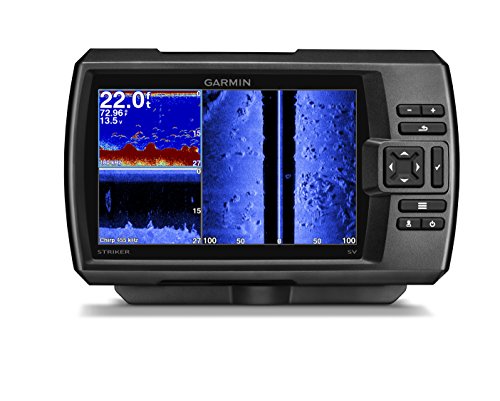
For boat anglers who prefer a larger screen, the original Garmin STRIKER 7sv offers a 7-inch display and GPS waypoint features. Compatible transducers can provide CHIRP, ClearVü and SideVü sonar views, helping show structure beneath and alongside the boat. The extra screen area is valuable for reading detailed sonar, but it also takes more mounting space and depends on a proper boat-power installation.
The STRIKER 7sv is an older model, and package contents matter. Confirm which transducer comes with the particular unit because that determines the scanning views you can actually use.
 Check Price
Pros: more display room and additional supported sonar views. Cons: bulkier installation and transducer-dependent features.
A Practical Buying Checklist
- Where will you use it? Choose a castable device for shore fishing or a wired unit if you regularly fish from your own boat.
- What will you read? Depth and bottom structure may be enough; GPS waypoints and scanning-sonar views are useful only when you need them.
- How will it be powered? Consider the boat battery, wiring, portable battery and smartphone before setting out.
- What is included? Check the transducer and mount in a wired unit’s package. Check app compatibility with a castable model.
- How easy is it to understand? A readable screen and straightforward menus can be more valuable than an impressive specification list.
Building an all-around fishing kit? Our guides to spinning reels, baitcasting reels, and saltwater spinning reels cover other useful tackle decisions. For packing or returning in dim conditions, a rechargeable flashlight can help with gear, although it does not replace proper boat navigation lights.
Best Fish Finder FAQs
Can a fish finder count fish accurately?
No. The display interprets reflected sonar pulses, which may represent fish, debris, vegetation or other targets. Fish icons are not a reliable head count. The skill lies in recognizing likely fish arches and reading the bottom.
Can I use Deeper sonar without cell reception?
Deeper’s compatible castable systems create their own Wi-Fi signals for sonar data, so cellular reception is not needed just to display readings. Some app features may need data previously downloaded or internet access.
Do all fish finders include GPS?
No. Garmin STRIKER 4 includes GPS waypoints, but the basic Lowrance HOOK-3x does not. And having GPS is not the same as including nautical navigation charts.
Does a larger depth rating mean a fish finder works better?
Not necessarily. Sonar quality depends on the transducer, frequencies, installation and water conditions. Buy for the actual depths and fishing environments you use most.
Final Verdict
The best fish finder depends on how you get onto the water. Choose Deeper Smart Sonar PRO+ if a castable, phone-based device with onshore mapping suits your bank or kayak fishing. The Garmin STRIKER 4 is a practical boat-mounted unit if you want a dedicated screen and GPS waypoints. For simpler sonar depth readings without GPS, the Lowrance HOOK-3x is a straightforward choice. Match the unit to your fishing routine rather than buying features you will never use.