
Last Updated on October 15, 2026
The Fenix PD32 may not be as bright as today’s high-output flashlights, but its simple controls, multiple lighting modes, and solid construction still make it useful. It is also easy to carry in a backpack, tool bag, or pocket.
One thing you should know before buying is that Fenix has released several versions of the PD32 over the years. The original 315-lumen model discussed in this review is an older flashlight, and newer versions offer much higher brightness and improved features.
If you want something compact for camping, hiking, fishing, or daily use, this Fenix PD32 review will help you understand what the original model can do and whether it is still a sensible choice in 2026.
Fenix PD32 Review 2026: Key Features
The original PD32 is built around a straightforward design. It doesn’t have the charging ports or extremely high outputs found on some modern models, but it includes several useful features.
- Durable aluminum construction: Aircraft-grade aluminum with a Type III hard-anodized finish helps protect the flashlight from everyday wear.
- 315-lumen maximum output: Provides practical illumination for outdoor activities and general use.
- Six lighting options: Four brightness levels, plus Strobe and SOS modes.
- IPX8 water resistance: Designed to withstand immersion under the manufacturer’s specified conditions.
- Dual-switch operation: A tactical tail switch controls power, while a side switch selects lighting modes.
- Battery flexibility: Compatible with either two 3V CR123A batteries or one suitable 18650 rechargeable Li-ion battery.
- Compact design: Easy to carry without the weight of a larger tactical flashlight.
Fenix has a long history of producing dependable lights for outdoor and professional users. You can explore other models in our Fenix flashlight reviews and buying guide.
Technical Features of the Fenix PD32 315 Lumen Flashlight
The following specifications refer specifically to the original 315-lumen Fenix PD32 with the Cree XP-G R5 LED.
| Features | Original Fenix PD32 |
|---|---|
| Maximum brightness | 315 lumens |
| LED | Cree XP-G R5 white LED |
| Rated LED lifespan | 50,000 hours |
| Brightness levels | 4: Low, Medium, High, Turbo |
| Special modes | Strobe and SOS |
| Maximum beam distance | 141 meters |
| Peak beam intensity | 5,000 candela |
| Maximum published runtime | 200 hours on Low |
| Turbo runtime | 2 hours, including automatic output step-down |
| Battery options | Two CR123A lithium batteries or one compatible 18650 Li-ion battery |
| Built-in charging | No |
| Body | Aircraft-grade aluminum |
| Finish | Type III hard-anodized anti-abrasive |
| Water resistance | IPX8, rated for immersion up to 2 meters |
| Impact resistance | 1 meter |
| Length | 127 mm |
| Diameter | 25.4 mm |
| Weight | 61 grams, excluding batteries and battery tube |
| Reverse polarity protection | Yes |
| Overheat protection | Yes |
| Original accessories | Holster, clip, lanyard, spare O-ring, and rubber switch boot |
| Price | 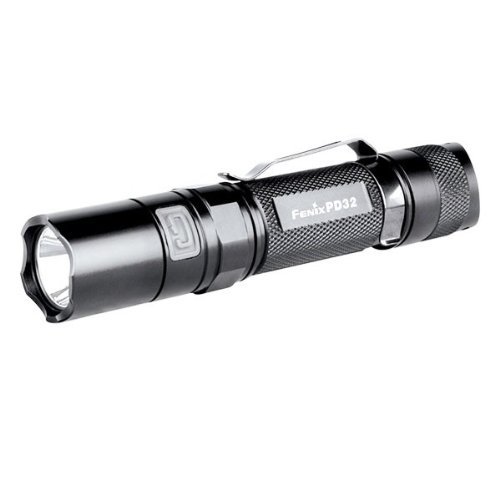 Check Today’s Price |
In this review, our focus is on the original PD32, its advantages, limitations, and everyday performance. We’ll also compare newer Fenix models so you can make a better buying decision.
Fenix PD32 Review: Features and Performance
1. Sturdy Construction
One thing that makes Fenix flashlights stand out is their durable construction. Like many other Fenix lights, the PD32 has an aircraft-grade aluminum body with a premium Type III hard-anodized anti-abrasive finish.
The finish protects the exterior from ordinary scratches and wear. The flashlight also features a toughened, ultra-clear glass lens with an anti-reflective coating. This protects the LED assembly while allowing light to pass through efficiently.
Its sturdy body gives it a dependable feel, whether you’re using it around the house or carrying it on outdoor trips. Of course, the flashlight is not indestructible, so it is still important to avoid unnecessary drops and impacts.
The overall design is simple, and that is one of its strengths. There are no complicated menus or unnecessary controls to worry about when you need light quickly.
2. Bright 315-Lumen Output
If you want a flashlight that provides dependable illumination in the dark, the original Fenix PD32 offers enough brightness for many common tasks.
It uses a Cree XP-G R5 white LED with a rated lifespan of approximately 50,000 hours. Its maximum output reaches 315 lumens, while the rated beam distance is 141 meters.
That may not sound particularly powerful compared with modern flashlights producing 1,000 lumens or more. However, brightness alone doesn’t determine how useful a flashlight will be.
The beam pattern, battery runtime, size, and controls also matter. For walking around a campsite, checking equipment, or finding something during a power outage, the PD32 provides practical illumination.
Keep in mind that the 141-meter figure is a manufacturer-rated maximum beam distance. It doesn’t mean every object at that distance will be clearly visible.
3. Four Brightness Levels Plus Strobe and SOS
One useful feature of the original PD32 is its selection of lighting modes. You can choose a lower brightness for close-up tasks or switch to a higher setting when you need more light.
The original 315-lumen model includes four regular brightness levels:
- Low: 9 lumens
- Medium: 70 lumens
- High: 130 lumens
- Turbo: 315 lumens
It also includes Strobe and SOS modes. Strobe produces a flashing light, while SOS is designed for emergency signaling.
For ordinary use, I recommend choosing the lowest setting that provides enough illumination. This can help you get more use from your batteries.
4. Battery Runtime and Brightness Performance
Battery runtime is important, especially when you’re camping or spending several hours away from home.
The original Fenix PD32 offers the following published performance figures.
| Mode | Brightness | Published Runtime |
|---|---|---|
| Low | 9 lumens | 200 hours |
| Medium | 70 lumens | 16 hours |
| High | 130 lumens | 8 hours |
| Turbo | 315 lumens | 2 hours, accumulated runtime |
| Strobe | 315 lumens | Not separately specified |
| SOS | 130 lumens | Not separately specified |
The manufacturer’s published figures are based on laboratory testing with CR123A batteries. Your actual runtime can vary depending on battery condition, temperature, and usage.
Another thing to remember is that Turbo output is regulated. The flashlight reduces its brightness after extended high-output operation, so the published two-hour Turbo runtime does not mean it maintains 315 lumens continuously for two hours.
For longer use, Low or Medium is usually the better choice.
5. Intuitive User Interface
The flashlight is easy to operate with one hand. Its tactical tail switch allows quick activation, while the side switch controls brightness and the additional lighting functions.
For many users, this is a convenient arrangement because they don’t have to cycle through every mode just to switch the flashlight on.
The body also offers a secure grip, and its anti-roll design helps prevent it from rolling away when placed on a relatively flat surface.
These details may seem minor, but they make the flashlight easier to handle during outdoor activities and everyday work.
6. Built for Outdoor and Tactical Use
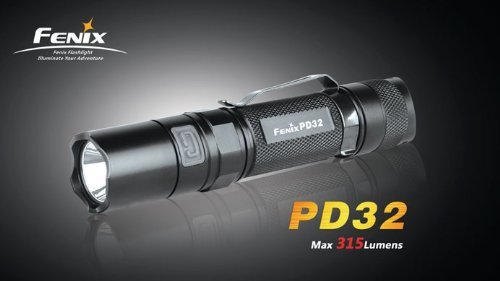
At 127 mm long and 25.4 mm in diameter, the original Fenix PD32 is small enough to carry in a backpack or coat pocket without taking up much space.
Its IPX8 water-resistance rating makes it suitable for wet environments. The manufacturer specifies an immersion depth of up to 2 meters.
However, water resistance does not mean you should use the flashlight for prolonged underwater activities. Make sure the head and tail cap are properly tightened and that the O-ring seals are in good condition.
The flashlight is also rated to resist impacts from up to 1 meter. This provides some protection against accidental drops, although repeated falls can still damage the housing, lens, or electronics.
For camping, hiking, fishing, dog walking, or security work, the PD32 offers a useful combination of strength and portability.
7. Powered by CR123A or 18650 Batteries
The Fenix PD32 can be powered by two 3V CR123A lithium batteries or one compatible rechargeable 18650 Li-ion battery.
This flexibility is helpful because you can choose a power source based on your needs.
CR123A batteries are convenient when you want to carry spare batteries for outdoor trips. They also perform well in cold conditions. An 18650 rechargeable battery may be more economical for frequent use because it can be recharged many times.
However, the original PD32 does not have a built-in charging port. If you use an 18650 rechargeable battery, you’ll need an appropriate external charger.
Never attempt to recharge disposable CR123A batteries. Also, do not mix batteries of different ages, brands, or charge levels.
Battery inclusion depends on the original package and retailer. If you’re purchasing an older PD32, verify what comes in the box.
8. Low-Voltage Warning
Another useful feature of the Fenix PD32 is its low-voltage warning system.
On supported later PD32 configurations, the flashlight gradually reduces brightness as battery voltage becomes low. At the lowest setting, a repeating flash alerts the user that battery replacement or recharging is needed.
The precise warning sequence can vary between PD32 generations. For the original 315-lumen model, follow the instructions supplied with that version rather than assuming it uses the same warning pattern as a later model.
Whatever version you own, don’t ignore signs of a weak battery. Carrying a spare compatible battery is useful when you expect to spend a long time outdoors.
9. Overheat Protection
Small, powerful LED flashlights generate heat when operating at higher brightness levels. The Fenix PD32 includes thermal protection and output regulation to help manage this.
On the original 315-lumen version, Turbo automatically steps down after approximately 30 minutes. Later PD32 versions can use different step-down timings, so it is important not to confuse their operating instructions.
If your flashlight becomes unusually hot, switch to a lower brightness level or turn it off until it cools.
Avoid covering the flashlight head while it is operating, and don’t leave it running inside a closed pocket or bag.
10. Reverse Polarity Protection
When changing batteries in the dark or in a hurry, it is possible to insert them in the wrong direction.
The Fenix PD32 includes reverse polarity protection to help protect the electronics against incorrect battery installation.
Even with this safety feature, you should always check the battery orientation before tightening the tail cap.
11. Compact and Lightweight Design
If you’re an outdoor enthusiast, having a compact flashlight is important. A large light may provide higher output, but it can also become inconvenient to carry all day.
The original Fenix PD32 weighs approximately 61 grams without batteries and the battery tube. Its slim body makes it easier to carry in a bag, pocket, or holster.
The included clip and lanyard also provide convenient carrying options.
If portability matters more than maximum output, you may also want to check our guide to compact pocket flashlights.
12. Warranty and Customer Support
Fenix Lighting USA offers a limited lifetime warranty on eligible products under its published terms and conditions.
Coverage may depend on where you purchased the flashlight, its age, the type of damage, and proof of purchase.
If an older PD32 develops an electrical fault, contact Fenix or the original authorized retailer before attempting to disassemble the flashlight.
Damage from misuse, unauthorized repairs, or ordinary wear may not qualify for free warranty service.
Fenix PD32 Troubleshooting Guide
Even a durable flashlight can develop problems after years of use. If your Fenix PD32 stops working or behaves unexpectedly, start with the battery and electrical connections.
Always switch off the flashlight and remove the battery before cleaning contacts or inspecting the battery compartment.
| Problem | Possible Cause | What to Do |
|---|---|---|
| Flashlight won’t turn on | Depleted battery, incorrect battery orientation, loose tail cap, or poor electrical contact | Check that the positive end faces the flashlight head. Try a known-good compatible battery and ensure the head and tail cap are tightened properly. |
| Light flickers or works intermittently | Loose connections, dirty contacts, worn springs, or battery problems | Remove the battery, clean accessible contacts with a soft dry cloth, inspect the springs, and tighten the connections. |
| Cannot change brightness modes | Side-switch obstruction, low battery voltage, or electronic malfunction | Check the side switch for dirt or physical damage. Try a fresh compatible battery. Contact Fenix support if the problem continues. |
| Turbo becomes dimmer | Normal output regulation, heat buildup, or declining battery voltage | Allow the flashlight to cool and check the battery. Some automatic brightness reduction is normal during extended operation. |
| Battery drains too quickly | High-output use, an aging battery, or damaged battery cells | Use lower brightness settings when possible and replace batteries that no longer hold a proper charge. |
| Flashlight becomes unusually hot | Extended high-output operation or a possible electrical problem | Turn the flashlight off and allow it to cool. Stop using it if excessive heating continues under normal conditions. |
| Moisture appears inside | Damaged O-ring, loose cap, or water exposure beyond the rating | Switch off the light, remove the battery if safe, and arrange inspection before using it again. |
How to Maintain Your Fenix PD32
Proper maintenance can help keep an older flashlight working reliably.
- Inspect the battery contacts for dirt or corrosion.
- Keep threaded connections clean and properly tightened.
- Check the O-rings for damage and replace worn seals.
- Use only compatible batteries recommended for the specific model.
- Remove batteries before long-term storage.
- Avoid prolonged operation at maximum brightness in confined spaces.
- Do not disassemble sealed electrical components.
- Contact an authorized service provider if the flashlight develops persistent problems.
Pros and Cons of the Fenix PD32
Pros
- Compact and lightweight construction
- Durable aircraft-grade aluminum body
- Four brightness levels with Strobe and SOS
- Easy one-handed operation
- Tactical tail switch for momentary activation
- IPX8 water resistance
- Compatible with CR123A and 18650 batteries
- Overheat and reverse polarity protection
- Anti-roll and slip-resistant body design
- Long published runtime on Low mode
Cons
- 315 lumens is modest compared with modern flashlights.
- The original model is discontinued.
- No built-in USB charging port.
- Turbo output does not remain at maximum brightness throughout the published runtime.
- Older switches and electrical contacts may develop wear over time.
- Finding an unused original model and replacement parts may be difficult.
Fenix PD32 vs. Fenix PD32 V2.0 vs. Fenix PD35 V3.0
If you’re shopping for a flashlight in 2026, it makes sense to compare the original PD32 with newer alternatives.
The PD32 V2.0 offers a major improvement in beam distance and output, while the PD35 V3.0 provides even higher brightness and more lighting modes.
| Specification | Original PD32 | PD32 V2.0 | PD35 V3.0 |
|---|---|---|---|
| LED | Cree XP-G R5 | Osram KW CSLPM1.TG | Luminus SFT40 |
| Maximum output | 315 lumens | 1,200 lumens | 1,700 lumens |
| Maximum beam distance | 141 m | 395 m | 357 m |
| Peak intensity | 5,000 cd | Approximately 39,000 cd | Approximately 31,800 cd |
| Battery | One 18650 or two CR123A | One 18650 or two CR123A | One 18650 or two CR123A |
| Brightness levels | 4 | 3 | 5 |
| Additional modes | Strobe, SOS | Strobe | Strobe |
| Built-in USB charging | No | No | No; supplied battery supports USB charging |
| Switches | Tail and side | Dual-stage tail switch | Tail and side |
| Length | 127 mm | Approximately 129 mm | Approximately 134 mm |
| Weight without battery | 61 g, excluding battery tube | Approximately 82 g | 83.5 g |
| Water resistance | IPX8 | IP68 | IP68 |
| Impact resistance | 1 m | 1 m | 1 m |
| Price | Check with specialist retailers or used-equipment sellers | Check Price (PD32R Listing) | Check Price |
Which Fenix Flashlight Should You Choose?
Original PD32: Best suited to people who already own the flashlight or prefer its straightforward design. It remains useful for general lighting, but its 315-lumen output is relatively modest today.
PD32 V2.0: A better fit for buyers who need a more focused beam and significantly greater reach. Its 395-meter rated distance makes it useful for checking objects farther away.
PD35 V3.0: A good option if you prefer higher overall brightness, multiple output levels, and the convenience of charging the supplied rechargeable battery.
For other outdoor and emergency lighting options, you can also explore our tactical flashlight comparison guide.
Is the Original Fenix PD32 Worth Buying in 2026?
The original PD32 is still a capable flashlight, but whether it’s worth buying depends on its price, condition, and the way you plan to use it.
If you already own one, there is no reason to replace it simply because newer models offer more lumens. The PD32 can still handle many everyday lighting tasks, including camping, walking at night, and emergency household use.
However, if you’re shopping for a brand-new flashlight, I would compare it with newer models before making a decision.
Higher brightness, improved beam distance, and more convenient charging options can make newer flashlights easier to live with, especially if you use them frequently.
The original PD32 was a good flashlight for its time. In 2026, its strongest appeal is its reliable basic design rather than cutting-edge performance.
Final Verdict: Fenix PD32 Review
The Fenix PD32 is a compact and lightweight LED flashlight that serves a wide range of purposes. Thanks to its durable construction, multiple lighting modes, and practical battery options, it remains useful for camping, hiking, fishing, walking the dog, and general emergency lighting.
I particularly like the straightforward dual-switch design, which makes the flashlight easy to operate with one hand. Features such as reverse polarity protection, thermal regulation, and IPX8 water resistance also add to its usefulness.
However, the original 315-lumen model has been discontinued, and newer Fenix flashlights now offer considerably more output.
For existing owners, the original PD32 is still worth keeping if it works properly. For new buyers, the PD32 V2.0, PD32R, or PD35 V3.0 may be better choices depending on their current availability and price.
Overall, I hope this Fenix PD32 review has helped you understand the flashlight’s features, limitations, and whether it still meets your needs in 2026.
Frequently Asked Questions
1. Does the Fenix PD32 come with batteries?
Battery inclusion depends on the version and package. The original 315-lumen PD32 can use either two 3V CR123A lithium batteries or one compatible rechargeable 18650 Li-ion battery. Check the retailer’s package contents before purchasing.
2. What accessories come with the original Fenix PD32?
The original package includes a holster, pocket clip, lanyard, spare O-ring, and rubber switch boot. Used or older stock may not include every original accessory.
3. How bright is the original Fenix PD32 flashlight?
The original model covered in this review provides a maximum output of 315 lumens. Later versions of the PD32 have different output specifications, so you should identify the exact model before comparing brightness.
4. Is the Fenix PD32 rechargeable?
The original PD32 supports a compatible rechargeable 18650 Li-ion battery, but it does not have a built-in charging port. The battery must be charged using an appropriate external charger.
5. Is the Fenix PD32 waterproof?
The original Fenix PD32 has an IPX8 water-resistance rating with a manufacturer-specified immersion depth of up to 2 meters. This makes it suitable for rain and accidental water exposure when properly sealed. It is not intended for prolonged underwater use.
6. What is the difference between the original PD32 and the PD32 V2.0?
The original 315-lumen PD32 uses a Cree XP-G R5 LED and has a rated beam distance of 141 meters. The PD32 V2.0 increases maximum output to 1,200 lumens and beam distance to 395 meters. It also uses a different switching system and has an IP68 rating.