
Last Updated on October 15, 2026
One of the first things I look for in a tactical flashlight is brightness. I also pay attention to battery runtime, construction, and how easily I can operate it in the dark. A flashlight may look impressive on paper, but it should also be practical to carry and use.
The XT12GT offers several useful features, including magnetic USB charging, adjustable brightness, a dual tactical tail switch, and an intelligent temperature control system.
In this Klarus XT12GT review, we’ll examine its specifications, lighting performance, battery runtime, advantages, drawbacks, and common troubleshooting problems. We’ll also explain how it compares with the newer XT12GT Pro so you can choose the right model.
Klarus XT12GT Review 2026: Key Features
The original XT12GT remains an interesting flashlight because it focuses on long-distance illumination rather than simply producing the highest possible lumen output.
- 1,600-lumen maximum brightness: Strong illumination for outdoor and professional tasks.
- 603-meter beam distance: Particularly useful for inspecting distant objects and open areas.
- Four brightness levels: Low, Medium, High, and Turbo.
- Strobe and SOS: Additional flashing modes for signaling and emergencies.
- Magnetic USB charging: Recharge the compatible installed battery without removing it.
- Dual tactical tail switch: Quick access to commonly used lighting functions.
- IPX8 waterproofing: Rated for immersion up to 2 meters under specified conditions.
- Intelligent temperature control: Helps regulate output when the flashlight becomes hot.
- Battery level indicator: Provides a convenient estimate of remaining battery power.
These features make the XT12GT suitable for camping, hiking, fishing, security work, nighttime property inspections, and general emergency preparedness.
Technical Specifications of the Klarus XT12GT Flashlight
The following specifications apply to the original Klarus XT12GT, not the newer XT12GT Pro.
| Features | Klarus XT12GT |
|---|---|
| Maximum brightness | 1,600 lumens |
| Minimum brightness | 10 lumens |
| Brightness modes | 4: Low, Medium, High, Turbo |
| Additional modes | Strobe and SOS |
| Maximum beam distance | 603 meters |
| Maximum rated runtime | 200 hours on Low |
| Turbo runtime | 1.2 hours, including regulated output |
| LED | Cree XHP35 HI D4 |
| LED lifespan | Approximately 50,000 hours (rated) |
| Battery | One compatible 18650 Li-ion battery; check manufacturer instructions for other supported battery configurations |
| Original supplied battery | Klarus 18GT-36 rechargeable 18650, 3,600mAh |
| Charging method | Magnetic USB charging connector |
| User settings | Tactical and Outdoor |
| Switch | Dual tactical tail switch |
| Body material | Aerospace-grade aluminum alloy |
| Water resistance | IPX8, rated to 2 meters |
| Impact resistance | 1 meter |
| Length | 161.5 mm (6.36 inches) |
| Head diameter | 45.2 mm |
| Body diameter | 25.4 mm |
| Weight | 159 grams without battery |
| Battery indicator | Yes |
| Thermal regulation | Yes, ITS temperature control |
| Original accessories | Rechargeable battery, magnetic charging cable, holster, lanyard and other package accessories |
| Price |  Check Today’s Price |
Klarus XT12GT Review: Real-World Performance and Features
1. Outstanding Long-Distance Brightness
One of the most impressive features of the Klarus XT12GT is its beam distance. The flashlight produces a maximum of 1,600 lumens and has a rated beam reach of up to 603 meters.
That makes it especially useful for open areas where you need to inspect something farther away. For example, it can help when checking a large property, walking across an open field, or navigating a dark trail.
The XT12GT uses a Cree XHP35 HI D4 LED. Its focused beam provides greater reach than many compact flashlights with similar lumen ratings.
However, it’s important to understand what the beam-distance rating means. A 603-meter rating does not mean every object at that distance will appear clearly illuminated. Actual visibility depends on surrounding light, weather, and the size and reflectivity of the object.
For close-up tasks, such as reading or searching through a backpack, the lowest brightness level is usually more comfortable.
2. Four Brightness Levels and Two Special Modes
I prefer flashlights that provide different output levels because maximum brightness isn’t necessary for every situation.
The Klarus XT12GT offers four regular brightness settings:
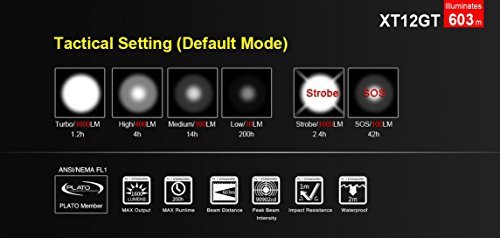
- Low: 10 lumens for close-up tasks and extended battery runtime.
- Medium: 100 lumens for general lighting.
- High: 400 lumens for stronger illumination.
- Turbo: 1,600 lumens for maximum brightness and distance.
The flashlight also includes Strobe and SOS functions.
Strobe produces a rapidly flashing light that may be useful for attracting attention. SOS provides a recognizable emergency signaling pattern.
For normal outdoor activities, Medium or High should be sufficient for many tasks. Turbo is better reserved for situations where you need maximum light for a short period.
3. Tactical and Outdoor Operating Settings
Another useful feature is the programmable user interface. The original XT12GT provides two operating settings: Tactical and Outdoor.
Tactical Setting: Prioritizes quick access to Turbo and Strobe. This can be helpful for professional users who need immediate high-output illumination.
Outdoor Setting: Provides convenient access to regular brightness levels and signaling functions for activities such as hiking, camping, and general lighting.
The exact button combinations depend on the selected setting, so it’s worth becoming familiar with the controls before relying on the flashlight outdoors.
I particularly like the idea of having separate operating settings. Someone who uses a flashlight for camping may prefer different controls from a security professional.
4. Dual Tactical Tail Switch
The Klarus XT12GT uses a patented dual tactical tail switch arrangement. This allows users to access lighting functions from the rear of the flashlight without constantly changing their grip.
The switches provide quick control over power, output, and special functions depending on the operating setting.
This design can be useful when you’re wearing gloves or holding other equipment.
One thing to remember is that the XT12GT and newer XT12GT Pro do not have identical control systems. Follow the manual for your particular model instead of assuming both operate the same way.
5. Aerospace-Grade Aluminum Construction
A tactical flashlight needs more than brightness. It should also have a solid body that can handle regular outdoor use.
The XT12GT is made from aerospace-grade aluminum alloy with a durable anodized finish. This helps protect the body against scratches, corrosion, and ordinary wear.
It also has a substantial head designed around its long-range reflector.
Although it is larger than many everyday carry flashlights, the XT12GT is still manageable for outdoor use. Its 161.5 mm length makes it easy to store in a backpack, vehicle emergency kit, or holster.
At 159 grams without a battery, it is not the lightest flashlight available. However, the additional weight is understandable considering its long-range design and sturdy construction.
6. Convenient Magnetic USB Charging
One feature that makes the Klarus XT12GT particularly convenient is its magnetic USB charging system.
Instead of opening a rubber-covered charging port, you connect the supplied magnetic charging connector to the flashlight.
This arrangement allows you to recharge a compatible installed Li-ion battery without removing it from the flashlight body.
It also reduces the need for an exposed conventional USB port on the flashlight itself.
However, there is one drawback: you need the correct magnetic charging accessory. If it is lost or damaged, a standard USB cable cannot connect directly to the flashlight.
Always use a compatible charging cable and battery recommended for the model.
7. Rechargeable 18650 Battery
The original XT12GT package was supplied with a Klarus 18GT-36 rechargeable 18650 Li-ion battery rated at 3,600mAh.
This is a useful capacity for a flashlight offering both powerful Turbo output and extended low-brightness operation.
A rechargeable battery can also be more economical than constantly purchasing disposable batteries if you use the flashlight frequently.
For emergency preparedness, carrying a properly stored compatible spare battery can be helpful.
Never mix different battery types or batteries with different charge levels. Also, avoid using damaged, swollen, or overheating Li-ion cells.
The original XT12GT uses an 18650 battery as its main rechargeable power source. The newer XT12GT Pro is designed around a larger 21700 battery, which is another important distinction between the two models.
8. Long Battery Runtime
Battery runtime is important when you’re camping or spending long hours outdoors.
The original XT12GT has a published maximum runtime of 200 hours at its lowest 10-lumen setting.
On Turbo, its published runtime is approximately 1.2 hours under the manufacturer’s specified test conditions.
However, this doesn’t mean the flashlight maintains a constant 1,600 lumens throughout the entire Turbo runtime. Brightness can decrease because of heat, battery voltage, and output regulation.
For general use, choosing Medium or Low can significantly extend the time between charges.
9. Intelligent Temperature Control
A flashlight producing 1,600 lumens can generate a noticeable amount of heat, especially when operating at maximum brightness.
To help manage this, the Klarus XT12GT includes an Intelligent Temperature Control System, commonly called ITS.
The system monitors operating conditions and regulates output when necessary to reduce excessive heat buildup.
This feature helps protect the flashlight, but it doesn’t mean the body will always remain cool.
If the flashlight becomes uncomfortable to hold, switch to a lower brightness setting or turn it off until it cools.
Avoid operating it on Turbo inside a closed bag, pocket, or other enclosed space.
10. Battery Status Indicator
The XT12GT also includes a battery capacity indicator, which helps you estimate the remaining battery charge.
The indicator uses different colors to communicate battery condition.
- Green: Approximately 70–100% battery capacity.
- Orange: Approximately 30–70%.
- Red: Approximately 10–30%.
- Flashing red: Below approximately 10%.
These are approximate ranges rather than precise measurements of remaining runtime.
The indicator is particularly helpful before a camping trip or when you expect to use the flashlight for several hours.
11. IPX8 Water Resistance
The Klarus XT12GT carries an IPX8 water-resistance rating, with a specified immersion depth of up to 2 meters.
This makes it suitable for rain, snow, wet trails, and accidental water exposure when properly assembled.
However, it is not a dedicated diving flashlight. Avoid prolonged underwater operation unless the manufacturer specifically approves it.
Check the O-rings and threaded connections regularly. Damaged seals can reduce the flashlight’s water resistance over time.
12. Easy to Carry and Store
The XT12GT is supplied with useful carrying accessories, including a holster and lanyard in its original package.
Its long-range head makes it less pocket-friendly than a small EDC flashlight, but it is still easy to store in a backpack or vehicle emergency kit.
If you need something smaller for daily pocket carry, our EDC flashlight guide covers more compact alternatives.
For users who prioritize beam distance over minimum size, the XT12GT offers a good balance.
Who Should Use the Klarus XT12GT?
The XT12GT is especially suitable for people who need a powerful flashlight with a focused long-distance beam.
- Campers and hikers: Useful for checking trails, campsites, and surrounding areas after dark.
- Security professionals: Provides quick access to strong illumination for inspecting outdoor spaces.
- Property owners: Helpful for checking large yards, fields, and other open areas.
- Emergency preparedness: A practical rechargeable light for keeping in a vehicle or emergency bag.
- Outdoor enthusiasts: Suitable for fishing, hunting-related outdoor lighting, and nighttime exploration where legally permitted.
If you only need to illuminate a small room or find items around the house, a less expensive compact flashlight may be sufficient.
Advantages and Disadvantages of the Klarus XT12GT
What We Like
- Powerful 1,600-lumen maximum output.
- Impressive 603-meter rated beam distance.
- Durable aerospace-grade aluminum body.
- Four regular brightness levels plus Strobe and SOS.
- Programmable Tactical and Outdoor settings.
- Quick-access dual tactical tail switches.
- Convenient magnetic USB charging.
- Rechargeable 18650 battery support.
- Useful battery capacity indicator.
- Intelligent temperature regulation.
- IPX8 water resistance.
- Up to 200 hours of published runtime on Low.
What Could Be Better
- The large reflector makes it bulkier than smaller EDC flashlights.
- Turbo brightness decreases during extended use.
- Requires a compatible magnetic charging cable.
- The original model offers a shorter rated beam distance than the XT12GT Pro.
- Uses an older 18650 battery configuration rather than the Pro model’s larger 21700 battery.
- Availability of the original model and replacement charging accessories may vary.
Klarus XT12GT Troubleshooting Guide
Like other rechargeable flashlights, the XT12GT can occasionally develop battery, charging, or switching problems.
Before attempting any troubleshooting, turn off the flashlight and inspect the battery for visible damage. Do not charge or reuse a swollen, leaking, or overheated Li-ion battery.
| Problem | Possible Cause | What to Check |
|---|---|---|
| Flashlight won’t turn on | Battery discharged, incorrect orientation, loose tail cap, or dirty contacts. | Check battery orientation, recharge a compatible battery, and ensure all connections are secure. |
| Charging does not start | Dirty magnetic contacts, faulty cable, incompatible battery, or poor USB power connection. | Inspect and gently clean the charging contacts. Try a suitable USB power source and compatible charging accessory. |
| Charging indicator shows an unusual warning | Battery voltage problem, poor contact, or charging fault. | Disconnect charging and inspect the battery. Consult the model-specific manual before attempting further charging. |
| Light flickers | Loose connections, dirty battery contacts, or a weak battery. | Remove the battery, gently clean accessible contacts with a dry cloth, and tighten the tail cap. |
| Switches do not respond as expected | Incorrect operating setting, low battery, or switch malfunction. | Check whether Tactical or Outdoor setting is selected and follow the original XT12GT manual. |
| Turbo becomes dimmer | Thermal regulation or reduced battery voltage. | Allow the flashlight to cool and use a properly charged compatible battery. |
| Battery drains quickly | Frequent Turbo use, aging battery, or charging problems. | Use lower brightness settings and check the condition of the rechargeable battery. |
| Moisture inside the flashlight | Damaged seal, loose connection, or excessive water exposure. | Switch off, remove the battery if safe, and arrange inspection before using the flashlight again. |
Maintenance Tips
Regular maintenance can help your XT12GT continue performing reliably.
- Keep the magnetic charging contacts clean and dry.
- Inspect the O-rings for cracks or wear.
- Check the battery compartment for corrosion.
- Use only compatible batteries and charging accessories.
- Remove the battery for long-term storage when appropriate.
- Keep the lens clean using a soft, suitable cloth.
- Avoid leaving the flashlight running on Turbo inside a bag.
- Contact a qualified service provider if electrical problems persist.
Klarus XT12GT vs. XT12GT Pro: Which Is Better?
The newer Klarus XT12GT Pro is a significant update to the original long-range flashlight.
Although both models have a maximum advertised brightness of 1,600 lumens, the Pro offers a longer beam distance, a different LED, and a larger rechargeable battery.
| Specification | Klarus XT12GT | Klarus XT12GT Pro |
|---|---|---|
| Maximum brightness | 1,600 lumens | 1,600 lumens |
| Beam distance | 603 meters | 850 meters |
| LED | Cree XHP35 HI D4 | Luminus SFT40 |
| Main battery | 18650 Li-ion | 21700 Li-ion |
| Typical supplied capacity | 3,600mAh | 5,000mAh |
| Maximum rated runtime | 200 hours | 288 hours |
| Charging | Magnetic USB | USB charging with magnetic connector |
| Primary switches | Dual tactical tail switches | Dual tactical tail switches |
| Length | 161.5 mm | 171.2 mm |
| Weight without battery | 159 grams | Approximately 171 grams |
| Head diameter | 45.2 mm | 45.2 mm |
| Water resistance | IPX8 | IPX8 |
| Impact resistance | 1 meter | 1 meter |
| Best for | Owners wanting the original long-range design | Buyers prioritizing maximum throw and longer rated runtime |
Which One Should You Choose?
Choose the original XT12GT if you already own it, have compatible charging accessories, and find its 603-meter rated beam distance sufficient.
Consider the XT12GT Pro if you’re buying a newer long-range flashlight and want the extra beam reach and larger battery configuration.
The Pro’s main advantage is its longer 850-meter rated beam distance, not higher maximum lumens. That distinction is important because lumen output alone doesn’t determine how far a flashlight can throw its beam.
Before buying either model, confirm the exact product version, included battery, and charging accessories.
Klarus XT11GT vs. XT12GT: Flashlight Comparison
Another flashlight worth comparing is the Klarus XT11GT. While the original XT11GT advertises a higher maximum lumen output, the XT12GT is designed to deliver a more focused long-distance beam.
| Feature | Klarus XT11GT | Klarus XT12GT |
|---|---|---|
| Maximum output | 2,000 lumens | 1,600 lumens |
| LED | Cree XHP35 HD E4 | Cree XHP35 HI D4 |
| Beam distance | Approximately 316 meters in commonly published configurations | 603 meters |
| Main battery | 18650 | 18650 |
| Maximum rated runtime | 170 hours | 200 hours |
| Charging | Micro-USB | Magnetic USB |
| Operating settings | Tactical and Outdoor configurations | Tactical and Outdoor |
| Switch design | Tactical tail switches and additional controls | Dual tactical tail switches |
| Length | 142.6 mm | 161.5 mm |
| Weight without battery | Approximately 130 grams | 159 grams |
| Water resistance | IPX8 | IPX8 |
| Impact resistance | 1 meter | 1 meter |
| Price | Check Price | Check Price |
The XT11GT may be more convenient if you prefer a shorter flashlight with a broader beam pattern. The XT12GT is more suitable when long-distance illumination is the priority.
For additional models, take a look at our Klarus flashlight comparison guide.
Is the Klarus XT12GT Still Worth Buying in 2026?
The original Klarus XT12GT remains a capable long-range flashlight, especially for people who already own one.
Its 1,600-lumen maximum output, 603-meter rated beam distance, magnetic charging, and durable aluminum construction still make it useful for many outdoor applications.
However, newer models such as the XT12GT Pro now provide greater beam distance and a larger battery configuration.
If you are shopping for a new tactical flashlight, compare the available versions carefully. A newer model may offer better performance, but the original XT12GT can still be a reasonable purchase if it is in good condition and priced appropriately.
Another factor worth checking is accessory availability. A proprietary magnetic charging connector is convenient when you have the correct cable, but replacing it can be less straightforward than using a standard USB cable.
Overall, the XT12GT is best suited to users who value a focused beam, tactical controls, and dependable rechargeable lighting.
Klarus XT12GT Review: Final Verdict
After examining its specifications and features, the Klarus XT12GT remains an impressive long-range tactical flashlight.
Its 603-meter beam distance is the feature that stands out most. While many flashlights produce high lumen numbers, not all are designed to send a concentrated beam over such a long distance.
The rugged aluminum body, magnetic charging system, dual tactical switches, and adjustable brightness settings also make the flashlight practical for outdoor activities and professional use.
There are a few limitations. The flashlight is larger than a typical pocket EDC light, its maximum brightness is subject to output regulation, and its magnetic charging system requires a compatible accessory.
For new buyers in 2026, the XT12GT Pro deserves consideration because of its improved 850-meter rated throw and larger battery.
Still, if you already own the original XT12GT, it remains a useful flashlight for camping, property inspections, outdoor work, and emergency preparedness.
I hope this Klarus XT12GT review has helped you understand its performance, strengths, drawbacks, and how it compares with newer Klarus flashlights.
Frequently Asked Questions
1. What is the maximum brightness of the Klarus XT12GT?
The original Klarus XT12GT delivers a maximum output of 1,600 lumens using its compatible rechargeable battery. The newer XT12GT Pro also offers a maximum advertised output of 1,600 lumens.
2. How far can the Klarus XT12GT beam reach?
The original XT12GT has a manufacturer-rated beam distance of 603 meters. The newer XT12GT Pro increases the rated distance to 850 meters.
3. Is the Klarus XT12GT rechargeable?
Yes. The original XT12GT uses a magnetic USB charging system that allows you to recharge its compatible 18650 Li-ion battery without removing the battery from the flashlight.
4. What battery does the Klarus XT12GT use?
The original XT12GT was supplied with a Klarus 18GT-36 3,600mAh rechargeable 18650 Li-ion battery. The newer XT12GT Pro uses a larger 21700 battery as its main power source.
5. Does the Klarus XT12GT have different lighting modes?
Yes. The original model has four regular brightness levels: Low, Medium, High, and Turbo. It also offers Strobe and SOS for additional signaling functions.
6. Is the Klarus XT12GT waterproof?
The XT12GT has an IPX8 water-resistance rating with a manufacturer-specified immersion depth of up to 2 meters. It is designed for wet outdoor conditions when properly sealed, but it should not be treated as a dedicated diving light.