
Last Updated on October 12, 2026
A trapezoid desk is a type of desk with a four-sided work surface shaped like a trapezoid. Unlike a traditional rectangular desk, it has one pair of parallel sides, usually with one side longer than the other. The angled edges make trapezoid desks particularly useful in classrooms, training rooms, and collaborative workspaces where furniture needs to be rearranged for different activities.
One of the biggest advantages of trapezoid desks is their flexibility. Students can use them individually during lessons or move them together to create larger work areas for group discussions and projects. Depending on their shape and dimensions, several desks can form hexagons, clusters, rows, or other arrangements. They can also be used in home offices and shared workspaces, although a traditional rectangular desk may be more practical for certain tasks.
Trapezoid Desks Dimensions: What Sizes Are Available?
The dimensions of trapezoid desks vary depending on the manufacturer, intended age group, and whether the desk is designed for individual or group use. Smaller student models may be around 30 to 36 inches wide, while larger trapezoid classroom tables may measure 48, 60, or even 72 inches across their widest side.
Desk depth also varies. Some classroom models are approximately 21 to 24 inches deep, while larger collaborative tables may have depths of 30 to 36 inches. These are examples of available sizes rather than universal measurements for every trapezoid desk.
Height is another important factor. Some student desks have fixed heights around 29 inches, while adjustable models may offer a wider range, such as approximately 22 to 34 inches, depending on the product. Certain classroom tables are available with even lower settings for younger students.
When comparing desks, check how the manufacturer measures the width. The longer and shorter parallel edges may have different lengths, so a single width measurement does not always describe the entire work surface. It is also important to measure the desk’s depth, leg clearance, and overall footprint.
If you are choosing a trapezoid desk for a small home office rather than a classroom, you may also want to compare compact desk options for smaller spaces. A conventional desk can sometimes make better use of a narrow room, especially if you need a permanent computer workstation.
How to Arrange Trapezoid Desks in a Classroom
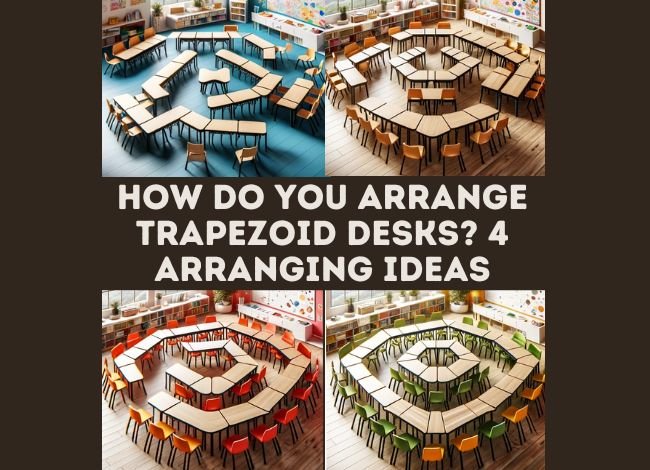
There are several ways to arrange trapezoid desks in a classroom, depending on the number of students, room size, and teaching activity. Their angled shape allows teachers to create different layouts without necessarily replacing the furniture.
Before arranging the desks, consider how students will see the board, move between seats, and communicate with one another. The most attractive layout is not always the most practical, especially if it blocks walkways or makes it difficult for students to face the teacher.
Here are some useful classroom arrangements:
- In rows: Arrange the trapezoid desks in straight or slightly staggered rows, with students facing the teaching area. This layout can work well for lectures, individual assignments, and tests. Make sure the angled desktop edges do not reduce the space available for students to enter or leave their seats.
- U-shaped arrangement: Position the desks around an open central area to create a U-shaped layout. This can make discussions easier because students have a clearer view of one another and the teacher. The exact arrangement depends on the desk angles and the amount of available classroom space.
- Circular arrangement: Place several desks in a circle or roughly circular pattern, with the students seated around the outside. This is useful for discussions and interactive lessons. Depending on the desks’ dimensions, the surfaces may form a closed shape or leave small gaps between them.
- Small groups: Combine two to four trapezoid desks to create collaborative work areas. Students can share materials, discuss projects, or complete group assignments without moving between separate workstations. This arrangement is particularly useful for activities requiring teamwork.
- Hexagon clusters: Some trapezoid desk designs can be combined to form a hexagonal work surface. For certain models, six desks fit together to form a complete hexagon. However, this depends on the precise angles and dimensions, so not every trapezoid desk will create the same shape.
Ultimately, the best way to arrange trapezoid desks depends on your students and the purpose of the lesson. You may find that rows work better for focused individual tasks, while small groups or hexagon clusters are more useful during collaborative activities.
It is worth testing a few arrangements before deciding on a permanent layout. Check that students can move their chairs comfortably, see the teaching area, and access classroom materials without unnecessary obstacles.
How Many Trapezoid Desks Make a Hexagon?
Six matching trapezoid desks can form a hexagon when they are specifically designed with the appropriate angles and dimensions. However, this does not apply to every trapezoid-shaped desk.
Some classroom furniture manufacturers design their trapezoid desks to connect neatly into hexagonal groups. Others use slightly different shapes intended for rows, staggered clusters, or irregular group arrangements.
Before purchasing a complete classroom set, check the manufacturer’s recommended layouts and dimensions. If possible, review a configuration diagram showing exactly how the desks fit together. This is particularly important when ordering several desks for group activities.
Who Needs Trapezoid Desks?
Trapezoid desks are most commonly used in classrooms and other educational settings where furniture needs to support both individual learning and group activities.
They can be especially useful for elementary and secondary school classrooms because teachers can change the seating layout depending on the subject or activity. For example, students might sit in rows during a written assessment and move their desks into groups for a science or art project.
These desks are also suitable for training rooms, tutoring centers, workshops, and collaborative learning spaces. Larger trapezoid tables can provide shared work surfaces for adult training sessions or team discussions.
In homes and offices, a trapezoid desk may be useful when you want an unusual furniture arrangement or a workspace that can be combined with other tables. However, its angled shape does not automatically make it more space-efficient than a rectangular desk. The actual benefit depends on the room layout and how the desk will be used.
Advantages and Disadvantages of Trapezoid Desks
Like any type of furniture, trapezoid desks have advantages and limitations. Their flexible shape makes them attractive for classroom use, but they may not be ideal for every workspace.
Advantages:
- Flexible arrangements: Desks can be placed individually or combined into rows, clusters, and other shapes.
- Suitable for group activities: Students can sit around combined work surfaces and share materials more easily.
- Useful for changing classroom layouts: Teachers can rearrange the furniture to suit different teaching activities.
- Available in different sizes: Smaller models are suitable for individual students, while larger tables can support collaborative work.
Disadvantages:
- Less convenient for some computer setups: The angled desktop edges may make it more difficult to position a large keyboard, monitor, and other equipment.
- Not every model fits together: Desks from different manufacturers may have incompatible angles or dimensions.
- Storage options may be limited: Many classroom trapezoid desks have simple frames without drawers or built-in cabinets.
- Layout planning is important: Some arrangements can occupy more floor space or reduce available walking paths.
What to Look for When Buying Trapezoid Desks
Before purchasing trapezoid desks for a classroom, check the construction, dimensions, and adjustment options. A desk that looks suitable in a product photo may not provide enough working space for your students.
Desktop size: Choose a work surface large enough for the materials students normally use, such as notebooks, textbooks, writing tools, or laptops. For shared tables, check how many people can sit comfortably around the available edges.
Height adjustment: Adjustable legs can be helpful in classrooms serving different age groups. The desk should allow students to sit with their feet supported and their arms comfortably positioned for writing.
Materials and durability: Look for a sturdy frame and a desktop designed for regular classroom use. Laminate and hard-plastic surfaces are common options because they can be practical to clean and maintain.
Mobility: Some trapezoid desks have casters, while others use fixed legs or floor glides. If you plan to rearrange the desks frequently, lightweight construction or lockable casters may be useful. Make sure mobile desks can be secured during use.
Stability: The desk should remain steady during writing and normal classroom activities. If you are evaluating older furniture, inspect the legs and connections carefully. You can also read our guide on common causes of a wobbly desk for general stability checks.
Safety and accessibility: Check that the edges are smooth, the legs do not create obvious trip hazards, and there is enough clearance for students to use the desk comfortably. Schools should also consider applicable accessibility requirements when selecting and arranging furniture.
Finally, confirm whether replacement parts, warranties, and compatible desks are available. This can be particularly important if you are purchasing furniture for an entire classroom and expect to expand the setup later.
Frequently Asked Questions About Trapezoid Desks
1. What is a trapezoid desk?
A trapezoid desk is a desk with a four-sided work surface that has one pair of parallel sides. Its angled shape allows it to be used individually or combined with other desks in different classroom arrangements.
2. What is the standard size of a trapezoid desk?
There is no single standard size for every trapezoid desk. Some individual student desks are approximately 30 to 36 inches wide, while larger classroom tables may be 48 to 72 inches wide. Depth and height also vary by manufacturer.
3. How many trapezoid desks can form a hexagon?
Six matching trapezoid desks can form a hexagon if their angles and dimensions are designed for that arrangement. However, some trapezoid desk models are intended for different configurations and may not fit together into a complete hexagon.
4. Are trapezoid desks better than rectangular desks?
Trapezoid desks are useful when flexible classroom arrangements and group activities are priorities. Rectangular desks may be more practical for permanent computer setups, individual workstations, or spaces where furniture needs to fit neatly against a wall.
5. Can trapezoid desks be used in a home office?
Yes, a trapezoid desk can be used in a home office if the dimensions and available work surface suit your needs. However, check whether the angled edges leave enough space for your computer, keyboard, mouse, and other equipment.
6. What is the best arrangement for trapezoid desks in a classroom?
The best arrangement depends on the activity. Rows are useful for individual work, U-shaped layouts can support discussion, and small groups or hexagon clusters are practical for collaborative projects. Always leave sufficient space for movement and clear views of the teaching area.
Final Thoughts
Trapezoid desks are a practical option for classrooms and shared learning spaces because they can be arranged in several different ways. Their angled work surfaces make it possible to create individual workstations, small groups, and larger collaborative areas without relying on one fixed classroom layout.
Before choosing trapezoid desks, compare their dimensions, height options, stability, and compatibility with other furniture. If you are buying several desks for a classroom, check the recommended configurations and make sure the arrangement provides enough space for students to sit and move comfortably.
With the right size and layout, trapezoid desks can provide a flexible workspace for different teaching activities and everyday learning.