
Last Updated on October 15, 2026
Fenix PD25 Review 2026: Is It Still Worth Buying?
The original Fenix PD25 remains a practical choice for anyone who wants a small flashlight with a tactical tail switch, adjustable brightness, and solid construction. However, it is an older model, and the newer Fenix PD25R offers several improvements, including USB-C charging, a maximum output of 800 lumens, and a longer beam distance.
That doesn’t make the original PD25 a bad flashlight. Its simple controls and compact design are still useful, especially if you already own one. For a new purchase in 2026, though, comparing the price and features of the PD25R makes sense.
Why Choose the Fenix PD25?
- Up to 550 lumens: Provides strong illumination for a flashlight of this size.
- Five lighting modes: Four brightness levels and one strobe setting.
- Compact construction: Measures just 93 mm long and weighs 47 grams without a battery.
- Battery flexibility: Supports one compatible 16340 rechargeable Li-ion battery or one 3V CR123A lithium battery.
- Reverse polarity protection: Helps protect the electronics if the battery is inserted incorrectly.
- IPX8 waterproofing: Designed to withstand immersion under the manufacturer’s specified conditions.
Read this complete Fenix PD25 review to learn about its technical features, actual lighting modes, battery performance, advantages, limitations, and common troubleshooting steps.
Technical Features of the Fenix PD25 Flashlight
The following specifications apply to the original 550-lumen Fenix PD25, not the newer PD25R.
| Features | Fenix PD25 |
|---|---|
| Maximum brightness | 550 lumens (16340) / 400 lumens (CR123A) |
| Minimum brightness | 5 lumens |
| Maximum runtime | 53 hours (16340) / 100 hours (CR123A) |
| Turbo runtime | 35 minutes (16340) / 1 hour 10 minutes (CR123A) |
| Modes | 4 brightness levels + strobe |
| LED | Cree XP-L V5 |
| Maximum beam distance | 130 meters |
| Maximum beam intensity | 4,225 candela |
| Body | Aircraft-grade aluminum |
| Finish | Type III hard-anodized anti-abrasive finish |
| Water resistance | IPX8, rated for 2-meter immersion |
| Impact resistance | 1 meter |
| Length | 93 mm (3.7 inches) |
| Diameter | 21.5 mm (0.8 inches) |
| Weight | 47 grams (without battery) |
| Compatible batteries | One 16340 rechargeable Li-ion or one 3V CR123A lithium battery |
| Charging port | No built-in flashlight charging port |
| Reverse polarity protection | Yes |
| Low-voltage warning | Yes |
| Battery included | Depends on the package or retailer |
| Price |  Check Today’s Price (PD25R Listing) |
If you work in security, law enforcement, maintenance, or another field where reliable lighting matters, a compact flashlight like the PD25 can be a useful backup. The tail switch provides quick activation, while the side switch makes it easy to select the brightness you need.
I prefer carrying a small flashlight alongside a larger light when working outdoors. A larger flashlight is useful when I need more coverage, but a compact model is easier to keep within reach for everyday tasks. That’s where the PD25 fits in nicely.
Fenix PD25 Flashlight Review (Video)
The Fenix PD25 is made from durable aircraft-grade aluminum with a Type III hard-anodized finish that helps resist scratches, corrosion, and everyday wear. Its toughened glass lens features an anti-reflective coating to improve light transmission and protect the LED assembly.
The Cree XP-L V5 LED delivers a maximum output of 550 lumens with a suitable 16340 battery. Its rated lifespan is approximately 50,000 hours, although actual service life depends on usage, heat exposure, and other operating conditions.
The side switch is straightforward to use. It lets you cycle through the four brightness settings and access strobe mode. Meanwhile, the tail switch controls the power and provides momentary activation when needed.
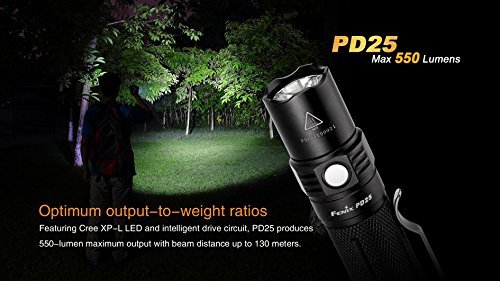
The PD25 can be used for security work, camping, fishing, hiking, and general outdoor activities. Its IPX8 rating provides useful protection in wet conditions, while the aluminum body withstands normal knocks and handling.
For overnight camping or emergency preparedness, you may also want to compare it with the models in our survival flashlight guide.
Fenix PD25 Product Description
- Durable aircraft-grade aluminum construction
- Toughened ultra-clear glass lens with anti-reflective coating
- Cree XP-L V5 LED with a rated lifespan of 50,000 hours
- Premium Type III hard-anodized anti-abrasive finish
- Metal side switch for output selection
- Maximum beam intensity of 4,225 candela
- Tactical tail switch with momentary-on function
- 550-lumen maximum output with a compatible 16340 battery
- Maximum beam distance of 130 meters
- Up to 100 hours of runtime on Low with CR123A
- IPX8 water-resistance rating
- Impact resistance up to 1 meter
- Anti-roll and slip-resistant body design
- Lanyard, holster, body clip, and spare O-ring in the original accessory package
- Length of 93 mm and diameter of 21.5 mm
- 47 grams without a battery
- Limited lifetime warranty terms provided by Fenix Lighting USA
Fenix PD25 Brightness Modes and Battery Runtime
One of the most useful features of the Fenix PD25 is the ability to choose between different brightness levels. You don’t always need the maximum output. When you’re reading inside a tent or searching through your backpack, a lower setting usually works better and saves battery power.
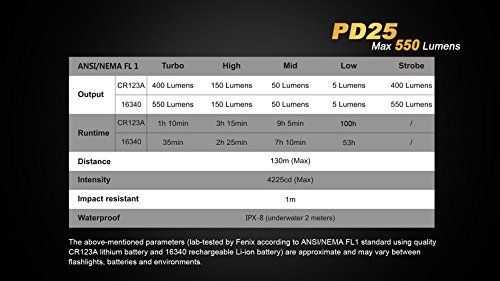
The PD25 has four brightness levels plus strobe. The runtime also changes depending on whether you use a rechargeable 16340 battery or a disposable CR123A battery.
| Mode | Output | 16340 Runtime | CR123A Runtime |
|---|---|---|---|
| Low | 5 lumens | 53 hours | 100 hours |
| Medium | 50 lumens | 7 hours 10 minutes | 9 hours 5 minutes |
| High | 150 lumens | 2 hours 25 minutes | 3 hours 15 minutes |
| Turbo | 550 lm (16340) / 400 lm (CR123A) | 35 minutes | 1 hour 10 minutes |
| Strobe | 550 lm (16340) / 400 lm (CR123A) | Not specified | Not specified |
These are the manufacturer’s published runtime figures. Actual performance can change with battery capacity, battery condition, temperature, and automatic output regulation. Turbo runtime should not be interpreted as a guarantee of constant maximum brightness throughout the entire period.
For long periods of low-level lighting, the CR123A offers particularly good performance in the original PD25. A rechargeable 16340 battery, on the other hand, allows the higher 550-lumen Turbo output.
Benefits and Features of the Fenix PD25
1. Durable Construction
The PD25 is strongly built to handle everyday use and outdoor conditions. Its aircraft-grade aluminum body feels more substantial than an inexpensive plastic flashlight, while the toughened glass lens protects the Cree LED inside.
The premium hard-anodized finish also helps the body resist scratches and corrosion. That doesn’t mean the flashlight is indestructible, but it should hold up well to ordinary outdoor use when properly maintained.
2. Easy-to-Operate Side Switch
Having a simple switch makes a real difference when you need light quickly. The Fenix PD25 is easy to operate because it separates the power and brightness controls.
The tactical tail switch turns the flashlight on or off and provides momentary illumination. The side switch near the head lets you cycle through Low, Medium, High, and Turbo. Strobe can also be activated using the side switch.
This arrangement works well if you regularly switch between close-up tasks and longer-distance lighting.
3. Lightweight and Compact Design
Another reason to consider the PD25 is its small size. The flashlight measures 93 mm in length and approximately 21.5 mm in diameter. It weighs only 47 grams without the battery.
That makes it easy to carry in a pocket, tool bag, or backpack. You can also attach the pocket clip to your belt or clothing.
For people who don’t want to carry a large flashlight all day, this compact design is one of the PD25’s biggest advantages.
4. Bright 550-Lumen Output
A flashlight isn’t very useful if it cannot provide enough light for the job. The Fenix PD25 produces a maximum of 550 lumens with a compatible rechargeable 16340 battery, which is impressive for its small body.
The flashlight’s rated beam distance reaches up to 130 meters. However, this is an ANSI-rated maximum distance, not a promise that every object at that distance will be clearly visible.
For walking outdoors, checking a dark area, or dealing with a power outage, the PD25 provides a practical range of illumination.
5. Five Lighting Modes
Fenix gives users several lighting options instead of forcing them to rely on one brightness level. Low mode is suitable for reading or close-up tasks. Medium works well for general use, while High and Turbo are better when you need more light.
Strobe provides a flashing signal that may be useful for attracting attention in an emergency. Avoid directing the beam into anyone’s eyes, especially at close range.
6. Low-Voltage Warning
The PD25 includes a low-voltage warning feature that helps alert users when the battery is running low. This is useful because you can replace or recharge the battery before the flashlight stops working unexpectedly.
For the best battery life, avoid leaving rechargeable Li-ion batteries fully discharged for extended periods.
7. Weather-Resistant Body
The Fenix PD25 has an IPX8 water-resistance rating, with a manufacturer-specified immersion depth of 2 meters. This makes it suitable for rain, wet outdoor conditions, and accidental exposure to water.
However, the rating does not mean the flashlight is designed for prolonged underwater operation. Always ensure that the head, tail cap, and O-ring seals are properly fitted before exposure to water.
After contact with saltwater or dirty water, clean the exterior carefully and dry it before opening the battery compartment.
8. Reverse Polarity Protection
Reverse polarity protection helps prevent damage to the flashlight’s electronics if the battery is accidentally inserted in the wrong direction.
Even with this feature, you should follow the correct battery installation instructions. The positive end of the battery should face the flashlight head.
9. Overheat Protection
A small flashlight can become warm when running at high brightness. This is especially noticeable on Turbo, where the LED and electronics produce more heat.
The PD25 uses output regulation and protection features to help manage heat. If the flashlight becomes unusually hot, turn it down to a lower mode or switch it off to cool.
Do not cover the flashlight head or leave the light operating inside a closed bag, especially on a high-output setting.
10. Compatible with 16340 and CR123A Batteries
The original Fenix PD25 accepts either one compatible 16340 rechargeable Li-ion battery or one 3V CR123A lithium battery.
A suitable rechargeable 16340 battery provides the flashlight’s highest 550-lumen output. A CR123A battery produces a lower maximum output of 400 lumens but offers longer published runtime at several settings.
Remember that CR123A primary lithium batteries must never be recharged. Also, do not install an unsupported battery or attempt to charge a battery inside the original PD25, since the flashlight itself does not have a built-in charging port.
11. Anti-Roll and Slip-Resistant Design
The body includes an anti-roll shape that helps reduce the chance of the flashlight rolling away when placed on a reasonably flat surface.
The textured body also provides a secure grip during ordinary use, particularly when your hands are damp.
12. Easy to Carry and Store
The original PD25 accessory package includes a pocket clip, lanyard, and holster. These give you several convenient ways to carry the flashlight.
You can keep it in your pocket, attach it to your belt, or store it in an emergency bag. Its lightweight design makes it practical to carry without much extra bulk.
Fenix PD25 Flashlight Troubleshooting Guide
Even a well-built flashlight can develop problems after repeated use. Most common issues involve batteries, electrical contacts, loose connections, or switch operation.
Before attempting repairs, remove the battery and inspect the flashlight for visible damage. Never use a swollen, leaking, overheated, or physically damaged Li-ion battery.
| Problem | Possible Cause | What to Check |
|---|---|---|
| Flashlight won’t turn on | Depleted battery, incorrect battery orientation, loose connection, or shipping insulation tab | Check battery orientation, try a known-good compatible battery, inspect the compartment, and tighten the head and tail cap. |
| Light flickers | Dirty battery contacts, loose head or tail cap, or weak battery | Remove the battery, gently clean dry contacts with a soft cloth, and check that threaded connections are secure. |
| Cannot change brightness | Obstructed or faulty side switch, low battery, or electronic fault | Check the side switch, replace or recharge the battery, and reinstall it. Contact Fenix support if the problem continues. |
| Turbo becomes dimmer | Thermal regulation, low battery voltage, or normal output regulation | Allow the flashlight to cool, use a compatible fully charged battery, and check the manufacturer’s runtime information. |
| Battery drains quickly | Frequent Turbo use, old battery, or damaged battery cells | Use lower modes when possible and replace aging batteries with approved replacements. |
| Water or condensation inside | Loose connections, damaged seals, or water exposure beyond the rating | Switch off immediately, remove the battery if safe, and arrange inspection before using the flashlight again. |
How to Maintain Your Fenix PD25
- Keep battery contacts clean and dry.
- Inspect O-rings regularly for wear or damage.
- Use only compatible battery types and sizes.
- Remove the battery for long-term storage.
- Avoid prolonged high-output operation in enclosed spaces.
- Do not disassemble the LED module or sealed electronics.
- Contact Fenix or an authorized service provider for persistent electrical faults.
Fenix PD25 vs. Fenix PD25R: What’s Different?
If you’re buying a compact Fenix flashlight in 2026, the PD25R is worth considering alongside the original PD25. The PD25R is the updated model and provides higher brightness, longer beam throw, and built-in USB-C charging.
| Feature | Fenix PD25 | Fenix PD25R |
|---|---|---|
| Maximum output | 550 lumens | 800 lumens |
| Maximum distance | 130 meters | 250 meters |
| LED | Cree XP-L V5 | Luminus SST20 |
| Brightness levels | 4 + strobe | 5 + strobe |
| Battery | 16340 or CR123A | 16340 or CR123A |
| Built-in USB-C charging | No | Yes |
| Water resistance | IPX8 | IP68 |
| Length | 93 mm | 92 mm |
| Weight | 47 g without battery | 78 g including battery |
| Best suited for | Owners wanting a compact, simple light | Buyers wanting brighter output and convenient charging |
The PD25R’s 800-lumen output and 250-meter beam distance give it an advantage for outdoor use. Its USB-C charging port also makes charging easier because you don’t need to remove the battery every time.
However, the original PD25 is still useful if you already own it and prefer its simple operation. The most important consideration is whether you need the upgraded brightness and charging features enough to justify buying a newer model.
Comparison: Fenix PD32 V2.0 vs. Fenix PD35 V3.0
For buyers who need more output than the compact PD25 offers, the larger PD32 V2.0 and PD35 V3.0 are worth considering. Both are designed for more demanding lighting tasks, although their size makes them less pocket-friendly than the PD25.
| Specification | Fenix PD32 V2.0 | Fenix PD35 V3.0 |
|---|---|---|
| LED | Osram KW CSLPM1.TG | Luminus SFT40 |
| Maximum lumens | 1,200 | 1,700 |
| Maximum beam distance | 395 meters | 357 meters |
| Maximum beam intensity | Approximately 39,000 cd | Approximately 31,800 cd |
| Battery type | One compatible 18650 or two CR123A batteries | One compatible 18650 or two CR123A batteries |
| Charging | No built-in flashlight charging port | Included rechargeable battery supports USB charging |
| Lighting modes | Low, Medium, High, Strobe | Eco, Low, Medium, High, Turbo, Strobe |
| Switch type | Single tail switch | Tail switch and side switch |
| Length | Approximately 129 mm | Approximately 135 mm |
| Weight | Approximately 82 g without battery | Approximately 84 g without battery |
| Water resistance | IP68 | IP68 |
| Impact resistance | 1 meter | 1 meter |
| Price | Check Price (PD32R Listing) | Check Price |
Which one should you choose? The PD32 V2.0 offers an impressive beam distance for its size, while the PD35 V3.0 provides higher maximum brightness and more lighting modes. If you mainly need a compact everyday flashlight, the PD25 or PD25R may be more convenient to carry.
Fenix PD25 Pros and Cons
What We Like
- Compact, lightweight design for everyday carry
- Durable aircraft-grade aluminum construction
- Up to 550 lumens from a small flashlight
- Convenient tactical tail switch and side switch
- Four brightness levels plus strobe
- IPX8 water resistance
- Supports both rechargeable 16340 and disposable CR123A batteries
- Reverse polarity and low-voltage protection
What Could Be Better
- No built-in USB charging port
- Lower maximum output than newer compact models
- Turbo runtime is relatively short
- Can become warm during high-output operation
- Older model, so finding the exact original version may be more difficult
- Battery and accessory bundles vary between retailers
Who Should Buy the Fenix PD25?
The Fenix PD25 is suitable for anyone who wants a small, sturdy flashlight that is easy to carry. It is particularly useful for household emergencies, camping, maintenance work, hiking, and everyday carry.
It also makes sense for people who already own compatible CR123A or 16340 batteries and don’t need built-in USB charging.
However, if you’re buying a flashlight for the first time and want greater brightness, longer beam reach, and easier charging, the PD25R is likely the more practical option.
Final Verdict: Is the Fenix PD25 Still a Good Flashlight?
Fenix has built a strong reputation for making dependable flashlights, and the original PD25 is a good example of the brand’s compact tactical design. Its aircraft-grade aluminum body, simple controls, and multiple brightness settings make it useful for a wide range of everyday situations.
With up to 550 lumens, a 130-meter beam distance, and support for two common battery types, the PD25 still provides useful performance. Safety features such as reverse polarity protection and low-voltage warning add to its practicality.
That said, the newer PD25R offers meaningful improvements. Its 800-lumen maximum output, longer beam distance, and USB-C charging make it easier to recommend for someone shopping for a new flashlight in 2026.
Overall, the original Fenix PD25 remains a dependable compact flashlight, especially for existing owners. But before purchasing one today, compare it with the PD25R and make sure the retailer is selling the exact model you want.
Frequently Asked Questions
1. How bright is the original Fenix PD25 flashlight?
The Fenix PD25 delivers a maximum of 550 lumens with a compatible 16340 rechargeable Li-ion battery. When powered by a 3V CR123A battery, its maximum output is 400 lumens.
2. What type of battery does the Fenix PD25 use?
It uses either one compatible 16340 rechargeable Li-ion battery or one non-rechargeable 3V CR123A lithium battery. Never attempt to recharge a disposable CR123A battery.
3. How far can the Fenix PD25 beam reach?
The original PD25 has a manufacturer-rated maximum beam distance of 130 meters, or approximately 427 feet. Actual useful visibility depends on weather, surrounding light, and the object being illuminated.
4. How many lighting modes does the Fenix PD25 have?
It has four brightness settings—Low, Medium, High, and Turbo—plus a strobe mode. This gives users five lighting options in total.
5. Does the original Fenix PD25 have USB charging?
No. The original PD25 does not have a built-in USB charging port. Compatible rechargeable batteries must be charged with an appropriate external charger or through an approved charging port built into the battery, if equipped. The newer PD25R has USB-C charging built into the flashlight.
6. Is the Fenix PD25 waterproof?
The original PD25 has an IPX8 water-resistance rating with a manufacturer-specified immersion depth of 2 meters. The newer PD25R has an IP68 rating, which includes dust protection. Always ensure the battery compartment is properly sealed before exposing either flashlight to water.