
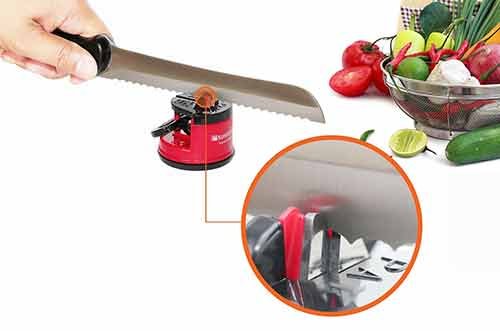
Last Updated on November 4, 2026
A dull kitchen knife often demands more pressure and can slip unexpectedly, but a sharpener that removes too much metal can also shorten the useful life of a good blade. The best knife sharpener should fit the steel, edge style and sharpening angle of the knives you already own. A two-stage electric model is convenient for ordinary kitchen blades, while a manual pull-through or pocket tool gives you a simpler option.
Below are three useful ways to sharpen knives, followed by five product reviews. Each product retains the image and matching Amazon link from the original article. Before choosing, check the manufacturer’s guidance for serrated, single-bevel and ceramic knives; not every sharpener supports them.
Our Recommended Top 3 Best Knife Sharpener Comparison Table
| Knife Sharpener | Type | Sharpening system | Best use | Main limitation |
|---|---|---|---|---|
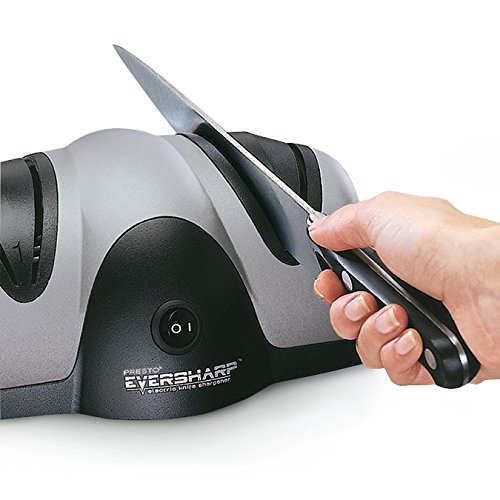 1. Presto EverSharp 08800Check Price |
Electric countertop | Two stages, Sapphirite grinding/honing wheels; guided angle | Most compatible straight-edge kitchen steel knives | 120V AC; not for ceramic knives, scissors or blades that do not fit |
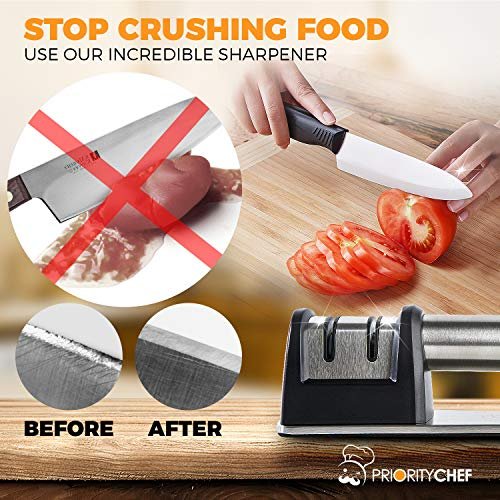 2. PriorityChef Two-StageCheck Price |
Manual countertop | Diamond-coated coarse stage and ceramic finishing stage | Straight-edge kitchen knives and routine home maintenance | Preset slots cannot match every specialty edge angle |
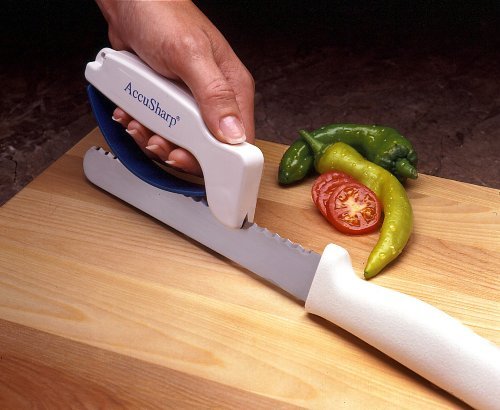 3. AccuSharp 001CCheck Price |
Handheld manual | Reversible diamond-honed tungsten carbide inserts; finger guard | Quick restoration of utility and everyday steel knife edges | Carbide can remove more metal than fine honing tools |
Why a Good Knife Sharpener Matters
A well-maintained edge slices food cleanly with less force. Sharpening removes a small amount of material to restore the edge; honing realigns or refines an edge that has already been sharpened. They are related tasks but not the same. Some devices combine a coarser sharpening stage and a finer finishing stage, and the appropriate choice depends on how dull the blade is.
Every sharpening method involves trade-offs. A coarse carbide tool can quickly restore a neglected utility blade, but it may remove more material than you want from an expensive chef’s knife. Fine stones offer greater control but require practice. Electric machines are convenient, but the knife’s geometry still needs to match their guides.
Types of Knife Sharpeners and Who Should Use Them
Electric knife sharpeners
An electric sharpener uses powered abrasive wheels and fixed guides to process both sides of an edge. Models like the Presto EverSharp 08800 are designed for common steel kitchen knives and help keep the sharpening angle consistent. Their main drawbacks are countertop space, the need for power and limitations with specialty blades. Check the voltage before plugging in a model purchased from another country.
Manual two-stage sharpeners
A manual two-stage sharpener typically has a coarse slot for edge repair and a fine slot for finishing. It requires no electricity and is easy to store in a kitchen drawer. The trade-off is that preset slots do not necessarily match Japanese single-bevel knives, very thin blades or other specialty edges. Use the fine stage for light maintenance when appropriate rather than automatically grinding every time.
Honing rods and whetstones
A honing steel or ceramic rod is used primarily for edge maintenance; a diamond-coated rod can abrade more material. Whetstones give you flexibility over angle and abrasive grit, but the method needs a stable surface and practice. They can be especially useful where the blade’s edge geometry is important and fixed slots are a poor match.
Portable knife sharpeners
Pocket-sized sharpeners such as Smith’s PP1 combine compact carbide, ceramic and diamond elements in one tool. They are handy for field maintenance, although their small handles demand careful control and they cannot match the precision of every dedicated sharpening system. Keep the tool in secure storage and use it on a stable surface rather than sharpening while walking or distracted.
Our Recommend Top 5 Best Knife Sharpener reviews
The buying guide above explains what to look for when choosing the best knife sharpener for the money. The following five knife sharpener reviews compare electric, countertop manual and portable sharpening tools, including their abrasive stages and compatibility with common kitchen knives.
Look at the knife’s blade type and sharpening angle before selecting a product. Presto, PriorityChef, AccuSharp, SunrisePro and Smith’s Pocket Pal all serve different maintenance needs, so the right sharpener is the one that restores your knives without removing more steel than necessary.
Jump to the knife sharpener reviews.
1. Presto 08800 EverSharp — Best Electric Kitchen Knife Sharpener
The Presto 08800 EverSharp uses a two-stage system with Sapphirite abrasive wheels. The first stage grinds a consistent edge while the second stage refines and polishes it. Built-in blade guides reduce the guesswork for compatible kitchen and sporting knives made of steel. It works best for people who maintain several everyday kitchen knives and prefer a machine on the counter to manual stones.
One crucial detail is the power supply: this model requires 120V AC. It is not designed as a universal worldwide-voltage appliance, so households using another voltage must not assume they can simply plug it in. Presto’s instructions also exclude scissors, serrated electric-knife blades and other blades that do not fit its slots. This is not a ceramic-knife sharpener. The motorized abrasive system is convenient, but do not repeatedly use the coarse grinding stage on an edge that needs only a light touch-up.
Advantages: consistent angle guides, powered two-stage operation, reliable manufacturer documentation and a straightforward design. Limitations: fixed angles, 120V power requirement and limited compatibility with specialty knives.
2. PriorityChef Two-Stage — Best Manual Countertop Sharpener
The PriorityChef combines a diamond-coated sharpening stage and a ceramic finishing stage. The diamond abrasive can help establish or restore a worn edge, while the ceramic stage refines it. It is compact enough for kitchen-drawer storage and requires no electricity. A stable non-slip base is especially useful because a sharpener that moves around on the counter is unpleasant and unsafe to operate.
This is a useful choice for ordinary straight-edged kitchen knives. It is not a substitute for a dedicated whetstone when you need to preserve an unusual blade angle or a very thin edge. Review the manufacturer’s blade compatibility before using it on serrated, single-bevel or specialty steel knives. Take light, controlled passes and stop when the edge is restored rather than grinding away additional steel.
Advantages: dual abrasive stages, compact design and no power cord. Limitations: fixed-angle slots and different results depending on knife geometry.
3. AccuSharp 001C — Best Quick Handheld Tool Sharpener
The original AccuSharp 001C is a handheld device with diamond-honed tungsten carbide sharpening inserts and a full-length finger guard. Its blades are reversible and replaceable, which can extend the tool’s service life. It is simple to store and well suited to people who want an inexpensive way to restore the edge on a common utility or kitchen knife.
Its strength is speed rather than finesse. Tungsten carbide can remove material quite aggressively, so it is not always the most suitable option for a high-end, extremely thin kitchen knife that needs a gentle polish. The finger guard helps protect the user’s hand, but the blade still needs to be held securely and the tool used according to its instructions. Check compatibility before trying any unusual edge.
Advantages: fast edge restoration, replaceable inserts and a useful hand guard. Limitations: coarse sharpening action can remove more steel than a ceramic finishing system.
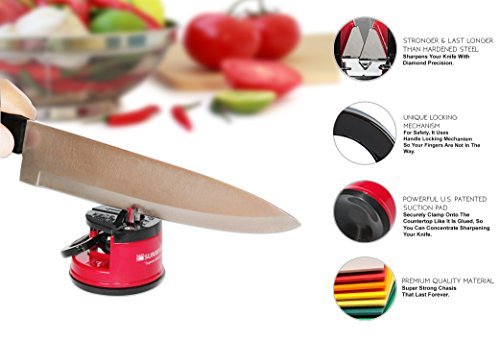
4. SunrisePro Knife Sharpener — Compact Suction-Base Alternative
SunrisePro is a small manual sharpener that aims to make edge restoration simple on a kitchen counter. Its suction-style base can help stabilize the tool on a clean, flat, nonporous surface. The sharpening mechanism is aimed at quick restoration of common steel edges rather than meticulous finishing of specialty chef’s knives.
Its size saves storage space, but a very small tool can be awkward if the suction base does not hold securely. Always inspect the surface and attachment before using it. Carbide-based edge restoration may remove more material than a fine ceramic or whetstone touch-up. It should not be assumed compatible with every serrated or ceramic blade just because its marketing claims to sharpen many knife types.
 Check Price
Advantages: compact footprint, simple use and minimal storage needs. Limitations: requires a suitable surface for secure attachment and may be too coarse for delicate edges.
5. Smith’s PP1 Pocket Pal — Best Portable Multi-Stage Option
Smith’s original PP1 Pocket Pal brings several sharpening functions into a compact package. It has a coarse crossed-carbide slot, a ceramic finishing slot and a fold-out tapered diamond-coated rod for suitable serrations and other small detailed edges. The ceramic slot is intended for refining already-sharpened edges; the carbide stage is better reserved for dull straight edges.
This is the most portable tool in the group and includes a lanyard hole. The diamond rod offers flexibility but, like any small sharpener, requires careful handling and does not replace a full sharpening system for every knife. It is also not a universal ceramic-blade sharpener, despite having ceramic sharpening material inside the tool.
 Check Price
Advantages: compact size, carbide/ceramic stages and a fold-out diamond rod. Limitations: little working surface and limited fit for specialty knives.
How to Choose the Best Knife Sharpener for Your Blades
Start with the type of knife
A conventional straight-edge stainless-steel kitchen knife can work with many manual and electric sharpeners. A high-end Japanese knife may have a different sharpening angle, while a single-bevel knife requires a different approach entirely. Ceramic knives need specialist diamond abrasives specifically approved for that purpose, not simply a tool with a ceramic finishing slot. Read our ceramic knife guide when comparing those blades.
Check edge angles and abrasive stages
A sharpener’s preset angle is an important specification. You can change a knife’s original angle unintentionally by using a mismatched guided slot. Coarse abrasives take away more metal, while finer stages are appropriate for polishing. If you are maintaining valuable knives, paying for a tool that suits their geometry is more useful than choosing the fastest option.
Consider space, voltage and maintenance
Electric machines use countertop space and a power source; manual models can be stored in drawers. Most pull-through sharpeners are relatively easy to wipe clean, while whetstones may require water or other manufacturer-specified maintenance. Keep sharpening tools dry where appropriate and away from children’s reach.
Whether you’re working with a kitchen chef’s knife or a fillet knife, check that the chosen sharpener supports the edge shape. Our pocket knife guide covers another category of cutting tools with different uses.
Knife Sharpening Safety and Care
Place the tool on a stable surface, keep the edge pointed safely away from other people, and follow the sharpener’s printed guidance. Never test a blade’s sharpness on your fingers. After sharpening a knife used for food preparation, wipe the blade so abrasive particles or metal filings are not left on the surface. Disconnect electric machines before cleaning. A knife with a damaged handle, loose blade or deep chips should be assessed rather than simply forced through a sharpener.
Sharpening equipment should be stored away from children. For broader tool handling context, see this workshop safety reference. If you also use heavier outdoor tools, the knife categories in our specialty knife guide have different care requirements.
Knife Sharpener FAQs
How often should I sharpen kitchen knives?
Sharpen when the blade no longer cuts cleanly or after honing no longer restores its performance. The frequency depends on how often you use the knife, the steel, cutting board, technique and abrasive. Sharpening on a rigid calendar can remove more metal than needed.
Can every sharpener handle serrated knives?
No. Some products have a compatible finishing slot or a tapered rod for serrations. Other models specifically exclude serrated blades. Read the manual for the exact tool rather than assuming that one advertised feature applies to all serrated edges.
Is an electric sharpener better than a whetstone?
Electric sharpeners are convenient and keep angles consistent for compatible knives. Whetstones offer more control over angle and grit, but require practice. Neither is best for every blade.
Can I use a regular knife sharpener on ceramic knives?
Usually not. Ceramic blades need a compatible specialist sharpening method, often involving diamond abrasives approved for the blade. A ceramic honing slot in a steel-knife sharpener does not make the device suitable for ceramic knives.
Does sharpening remove metal?
Yes. Every abrasive sharpening operation removes some material. Use coarse stages only when necessary and do not continue once the edge has been restored.
Final Thoughts
Presto EverSharp 08800 is a practical electric option for compatible straight-edge steel knives where 120V power is available. PriorityChef is a compact manual alternative with diamond and ceramic stages. AccuSharp 001C focuses on quick restoration with coarse carbide inserts, while SunrisePro and Smith’s Pocket Pal address other storage and portability needs. The best knife sharpener is the one that maintains your blades without changing their edge geometry unnecessarily.
For general food-preparation blades, read our fillet knife reviews alongside the sharpening guidance so the knife and sharpener suit each other.